Showing posts with label birds. Show all posts

Friday, November 28, 2025

Wednesday, April 5, 2017

Four cardboard toys: knight, emu, unicorn and horse

*


 Knight-Errant


 Emu, perhaps.


Unicorn


Horse (detail of neck and head)


Some questions


At what point is a representation so abstracted that it ceases to convey the thing it purports to? Using only cocktail sticks and corrugated card, and limiting oneself to glue to join elements, what can one come up with? 

Would it be a good idea to paint the pieces? Or would that be to take them away from that playful abstracted area where the mind is teased into the area of mere imitation?

They are not refined. Does that matter? Is it nice to see how simply they are constructed?


*

Saturday, June 7, 2014

Bird

Bird


Taken from my window.

Friday, May 3, 2013

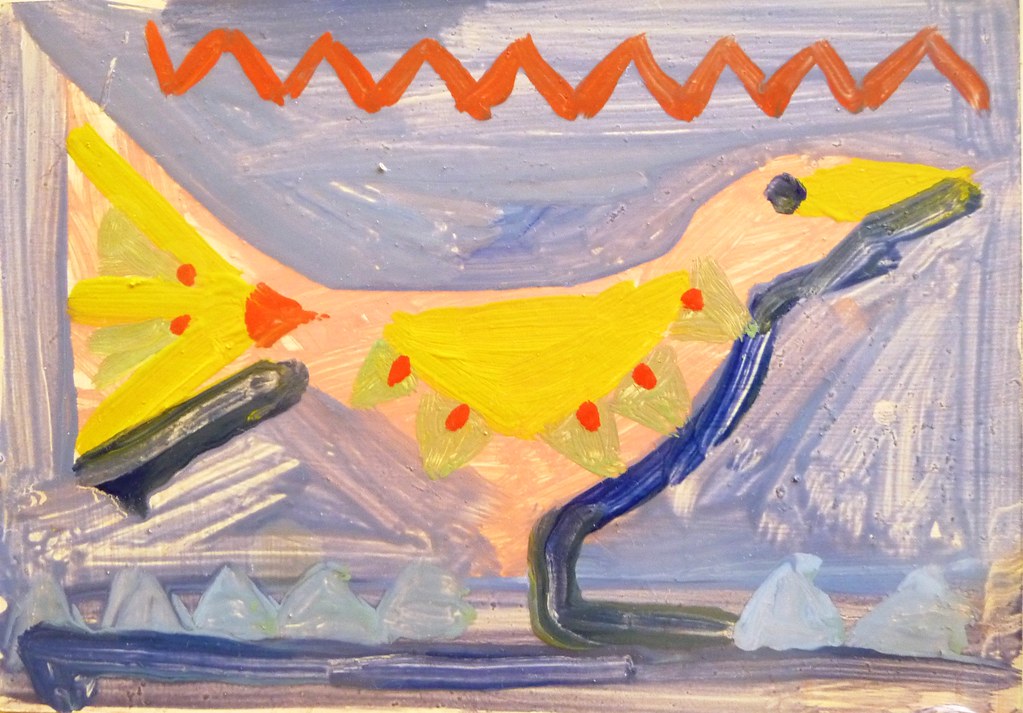
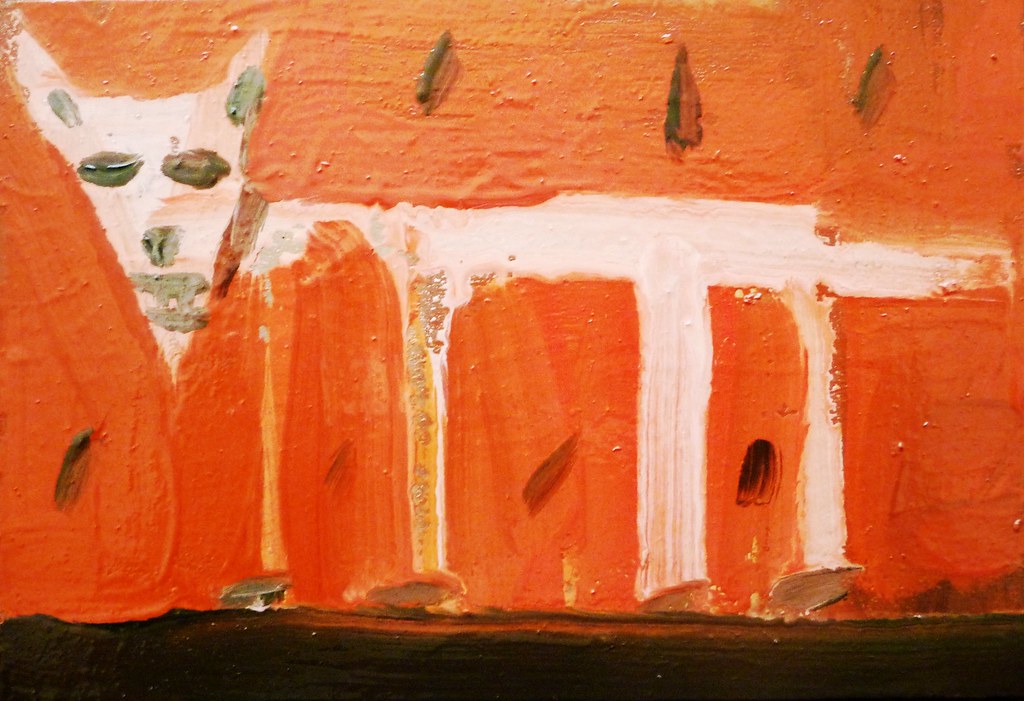
The yellow bird; the fox; bestiary

The yellow bird, oil on card, 17.5 x 12.5 cm


Alas I suppose there is some of Picasso (not my favorite painter by any means) in this: I love painting animals, so did he,but my regular landscape work doesn`t often accommodate this. So I will paint things like this from time to time. 

I recall a children`s book called The Painted Bird (perhaps I misremeber the title?) beautifully illustrated about a painter and how a bird he painted comes to life. I`m not referring to the 1965 novel by Jerzy Kosiński.

 The fox, oil on card, 16 x 11 cm


These two are the first in a bestiary, which I hope you enjoy.

Tuesday, April 17, 2012

Birdshead revisited


Returning to an earlier set of pieces: the birds.

 I had worked on them and they had become more and more like very obvious toys. I like toys, but the toys I like have a sense of abstraction about them, which is what lends them their charm (contrast Britains' very realistic animals and soldiers and cars with the far more abstracted tin soldiers and cars of earlier epochs).

I'd forced the pieces, making them far too explicitely "fun" and decorative when I should have let them be, allowing the viewer more space to draw their own interpretations.

Thus, in the guise of Redon, I return.

I also began making some horses: again I haven't found quite the equilibrum between a sort of Giacometti abstraction and realism, and they became too cute: I shall persevere.

Thursday, March 4, 2010

A selection of finished birds; painting the birds


The birds are nice to hold, and striking to see.


The enamel paint that I used is smooth and thick but can disguise only the slightest surface irregularites. So, for the birds to achieve their true potential, their surfaces should be much smoother before painting.


The paint is too thick to allow delicate detailing, so the birds' designs must aim for boldness over complexity.


In general, I am happy with this batch: the birds are bold and amusing, and there are inevitably hitches in any new projects.

And craft processes proceed in very definate stages, so if you screw up in one of the stages, you usually have to take several steps back to rectify your mistake; given that each stage usually has to dry, experimentation can become laborious.


Wednesday, March 3, 2010

Birds

A finished bird*


Wire legs inserted, a papier mache bird prepares itself to be covered in a plaster/pva/ water mix in an experiment for improved surface smoothness.

Three birds and one boy are covered liberally in the paste, whioh has the consistency of double cream....

...then they are hung out to dry.

This is attempt to improve surface smoothness of papier-mâché. The enamel paints I use do disguise a multitude of sins, but not enough to make such experiments redundant.

*Chateau Esclimont, photo by Frederick Evans, pub. Mitchell Beazley 1994 in "The Chateaux of France" by Marcus Binney.

Sunday, February 28, 2010

Papier-mâché birds - Final stages, finishing touches

All the birds need some last touches: from left to right: Woodpecker - detail beak and face; Blue- paint legs; White - detail the eyes; Blue (open beak)- make adjustments to legs/claws; Brown- repaint beak; Boy- paint; Small white bird - improve tail and eyes; Heron- repaint beak


This sort of work can go on and on: I suspect that folk art, which often uses labour intensive methods, came into being partly to use up time.

Perhaps because Papier-mâché is a new medium for me, I don't know quite when to declare the piece over. In truth, I don't really have the patience for very slow craft processes, aso anything I work on has to be finishable in about 4 stages or I go very much off the boil. Also, I think the charm of these things must lie in their hand-made roughness, and the level of abstraction that comes with it.

Papier-mâché has existed for centuries but there isn't - so far as I can see from the various sites- a real canon of Papier-mâché artists. This means one can make it up as one goes along.

This is something of a relief coming from the world of Fine Art, where one is constantly aware of a pressure to compare onself and compete, even with various "Masters".

When I've finished these birds I shall probably make some aeroplanes.

Saturday, February 13, 2010

The birds on parade following their first coat of paint.

Here they are. I dont have certain colours, so my choices are limited. But in a way that is good, because it lends a sense of unity to the collection.

I feel that the simpler the bird are, the more likable. There is another weeks work in tightening up the details.

Tuesday, February 9, 2010

Papier-mâché birds - stage 3; some lessons


Two birds after he first stages of painting.

I have learnt the following things about modelling in papier-mâché and plaster.

1. An armature saves a lot of grief.
2. While plaster can be used to smooth surfaces it cannot be used to model them, as it is brittle and breaks off the paper mache surfaces. Plaster cannot, therefore be used for modelling details either.
3. A certain plastic glue ("Puttex") is good for smoothing surfaces. But it cannot be easily sanded, so you have to smooth it carefully before leaving it to dry.
4. The surface of papier mache is perhaps never going to be eggshell smooth.
5. Papier mache made with white pva glue and water creates a stronger form than that made with wallpaper glue. It is also smoother.
6. Papier-mâché is not good for detailed modelling. The forms made have to be quite simple.
7. The process is quite slow. Allowing drying time betweeen papier-mâché sessions, I suppose one should allow up to two weeks to make a little bird such as the one above.
8. Painting hides some blemishes, but not many.

Sunday, January 31, 2010

Papier-mâché birds - stage 2 - leg surgery

Bird with leg implantations.

I am using polyfilla to help make the birds' surfaces smooth for painting.

The Anatomy Lesson of Dr Bird

The birds observe the leg surgery: Woodpecker's abdomen has been opened: he will subsequently recieve the wire implantation, which will then be bent to form limbs.


The Consultant Surgeon and Assistant Surgeon discuss procedure.


The Birds do not always balance easily. This Hornbill has cheated using blu-tack to hold on. Perhaps I will need to made a little base for him- I hope not, as this strikes me as inelegant.

Friday, January 29, 2010

Papier-mâché birds; toys and sculpure


Here's a collection of papier mache birds I've been working on over the last few days.

The thing is to find the right degree of anthropomorphism: the right balance between bird and suggested human characteristics for them to be fun.

They need to dry a little before I can work more into them, making their surfaces more even and improving their tails and beaks. Later they will be painted.

***

At what point does a toy become a sculpture? At the point at which it is too precious or serious looking to be played with, I guess.*

Play is regarded with tremendous suspicion in our culture though it lies beneath so many artistic endeavors. I suspect play is regarded with suspicion because it is regarded as the opposite of work, and Western societies are very much in thrall to the Protestant Capitalist ethos, whereby all activities must have a known, profitable end- to the extent that people are encouraged to feel bad about themselves when they aren't working, no matter how unfulfilling the jobs available to them are.

*Alexander Calder is an exception to this. Paul Klee, like Picasso, is playful but you couldn't really play with his works. Perhaps readers have other examples?

Tuesday, September 29, 2009

Bird Skull


I found this over at Ribeirao on the shore. I don't know the species of bird. Do you?

Shells collect in amazing piles on parts of the shore. They grow oysters there and the water must be very clean. They sell shells in two little shops, though I saw none of a type that would have been new to my collection.