Showing posts with label why make art. Show all posts

Saturday, April 20, 2013

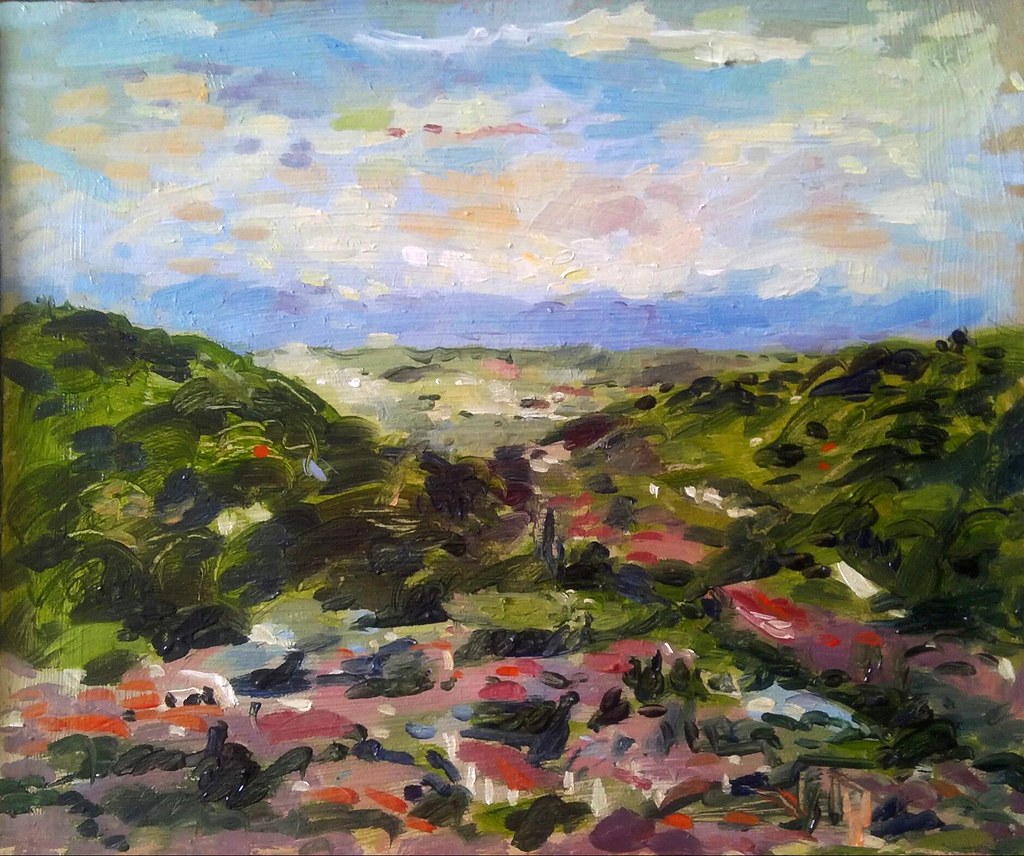
Curtains

Curtains, oil on card, 12.5 x 14 cm

It`s great to be working with high fast colour. I love laying out the colours and mixing them just seeing what happens when they meet.

Do we really need an obvious subject for a painting to be enjoyable?


Saturday, October 20, 2012

Painting in Tuscany; thanks and thoughts

*


Viareggio, Tuscany, oil on card, 12 x 14.5 cm


Well, that brings to a close my trip.

It was a wonderful trip and I want to thanks everyone who helped me: my parents,the people in Tuscany, Steve in the Beehive Hotel in Rome for restaurant recommendations,  Julie for company over dinner, and to Patrizia in Bari for taking me to Monopoli and buying me beer.

And many thanks to Sarah and Stefano in Tuscany for their hospitality and meals.

Other pleasant encounters were the sweet guy in the Lecce who runs the tourist information for giving me a ride on his scooter with my luggage, pleasant if surely eccentric hotel owners in Orvieto and the Italians in general for being kind and tolerant with ignorant British painter travellers.


***


From an artistic perspective, one always hopes there is some definitive lesson from a trip, but there rarely is.  There is a fine interview with Chuck Close and he states that all  the ideas he ever got came form the act of painting itself. Which is a way of stating, perhaps, that talking about it isn't that valuable.

 I feel more and more that this travel painting thing is analogous to fishing: you pick your equipment, your reels and hooks and lines, you think about what you want to catch and you go towards the place. And you might be luck you might not. A good number of days are  wasted and a good number of pictures are poor. I never know until some days after which are the good and the bad, and it almost embarrasses me how little I can trust my own immediate judgment.

The best paintings occur when one is in the zone, meaning that in that mindset where one is not really thinking about what one should or should not do but simply fulling engaged with whatever one is engaged with.

You know instinctively when a picture is fake or forced, but I don't know the words to  detail that instinct, and I doubt anyone else does either. Like many artists I spend my time often wanting to be another painter, one whose work I've seen and admire. Fortunately, incompetence or the mere ridiculousness of such an ambition forces me to work in way that is my own.


*


Next trip: London, Egypt and Scotland in January, if the Egyptians haven´t gone completely kookoo that is, in which case it'll be Jordan.


BETTER DROWNED THAN DUFFERS IF NOT DUFFERS WON'T DROWN


*

Tuesday, October 16, 2012

Painting in Rome : buildings

*


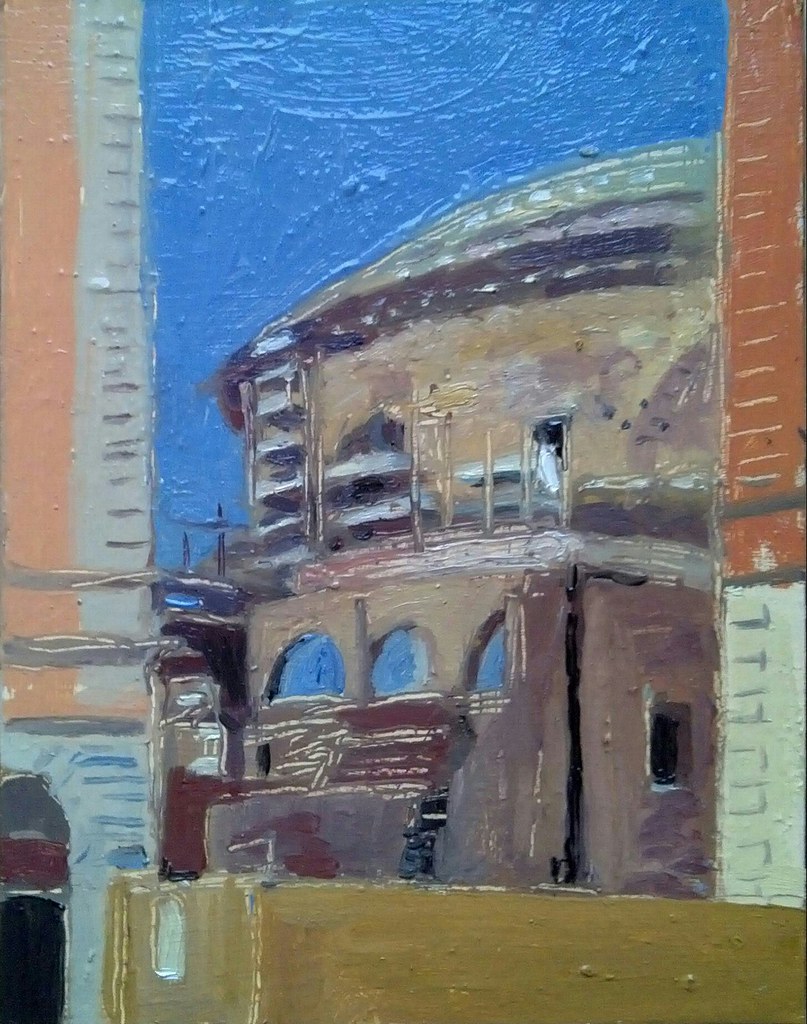
St Peters, Rome, oil on card, 13.5 / 16 cm    SOLD


Behind the Parthenon, Rome, oil on card, 10.5 / 13.7 cm unavailable


I'd had the idea of tackling more of the famous buildings but when I got to them felt disagreeable, the declamatory style of architecture and insistent presence of mass tourism combining to persuade me to so see refuge in Rome's wonderful parks and gardens- of which more tomorrow.

This touches on the way that tourism has the effect of so often destroying what it purports to celebrate, ones the sense of private discovery is lost among the hordes, to which I, of course, contribute, while hypocritically deriding.

The value of art is in the revealing of secrets, a butterfly chase: the skill is to capture and preserve an elusive emotion in your aesthetic net. The next major trip is Egypt- almost equally scrutinised, alas.


*

Saturday, August 27, 2011

Pochades: an attempt at self-criticism

*

A selection of pochades


I'm going through the pochades of the last three years, dating and titling the backs, varnishing them, deciding if any should be discarded (always a delightful feeling to paint over the dodgy ones, as if someone has taken an invisible rucksack from my back) seeing if I can draw any general conclusions from seeing them en masse.

My conclusions are:

1. The best pictures are not fuzzy. There is a clear focus. When first I began painting the pochades about three years ago I was somewhat under the influence of early photography. I liked the blurriness of those early Victorian images, and even more that of symbolist photographers as in the Camera Work group. 

On reflection, this influence was baleful: the dreamlike effects are a way, Ithink, of artists escaping responsibility, of saying in effect: "it is not up to us to direct you, all we do is provide a certain stimulus".

2. There is a minimum amount of work that the pochades have to show. That is, there must evidently be a transformative process on display, so that the viewer cannot dismiss the piece as mere.

3. The better pictures use clear, clean colours. Initially, I used often somewhat muted colours. I feel this was a mistake, and the result of cowardice: fear of colour

4. The best pictures are very rooted in direct experience, especially a sense of excitement with places or people. This has to be balanced with knowledge. If a place is totally new then it is often overwhelming, but this is better than if it is too familiar, because then it doesn't inspire at all. It is surprising how many of the best pictures come from being in a place for the very first time and I kick myself for not having pursued the delights of travel painting more vigorously before.

5. There is good attention payed to surfaces and textures.

6. There seems to be a maximum size in which I can give the picture sufficient attention within the hour and a half that one session lasts. So pictures larger than about 10cm sq in surface area are generally too large for the results to be satisfactory.

7. There is little gimmicky work. This is good.

*


Tuesday, June 21, 2011

Two recent pochades with coins for scale; painting pochades


Two recent pochades with coins for scale: a Brazillian centavo, a British penny, a US quarter and a Euro.

The size below has become roughly my standard- a little smaller than a postcard. The paintings are completed in about an hour, which is a good length of time to paint plein air here in Brazil, giving the speed of changing atmospheric conditions (in the UK it is might be less), and it allows me to produce a "finished" looking picture on this size. I sometimes work a little larger, and as above, sometimes smaller- though I find this somewhat fiddly.

I like working quickly, and in a burst: I find it exciting, in a way that is analagous to being a live performer. Instead  of making a studio recording: it stands or fails as I make it, there's no secondary editing process. I produce a good number of duds, at least 10%.

A certain number of duds are a certainty at any scale: that's a necessary collorary to being at all experimental, but at least I don't spend weeks and much money producing them. It is difficult for me to know immediately whether a picture is a dud or not and sometimes I am decieved, only realising later that a picture is poor. But it is very hard for me to find guiding principles: the jugement is subjective and falls outside words. This is one of the things that animates me to make art: the simple difficulty in knowing for sure which guiding principles- outside mere technical judgements- will produce good pictures.

The paintings can be easily stored and posted, and are accessable to people on lower incomes.

Saturday, July 18, 2009

What's the point of making stuff?


To clarify my mind- some questions I have been asking myself abut my work (not listed in any order).

1. Who is it for?

- Anyone who likes them. There's no target public, but it's usually people who have a taste for the macabre.

2. What will you do with them after you have photographed them?

- I'll put somewhere or chuck them out them, depending on space. The latter is more likely, though. I'm going to extend this disposablility to ther stuff I make, including paintings- so I'll re-use canvases once I've photographed them.

3. Are they for sale?


- Yes, the price is low. Write me, (Tadeusz598@yahoo.co.uk)and I’ll get back to you.

4. What do they mean?


- Meaning is hard to define in visual art. It isn’t proscriptive. These pieces have a function which is to make life more amusing. I guess I’m trying to draw attention to the strangeness and ambiguity that is everywhere, and to add to it.

5. Why do you like making things?

- I like being surprised by what happens when you play with materials. I think the essence of creativity is play. It's an instinctive delight in materials and their communicative possibiliies.
The technique here is very clean- scissors and card. It's not too difficult and because there is only a limited art tradition connected with paper cutouts, they feel fresh and fun to make. I don't know where they will lead to, which I quite like too.

6. What is the point of making things when there are already so many?

- To satisfy your own creative desires, and entertain others.

I say entertain, because before an artwork is anything else it has to entertain, or the public won't be drawn in. It's not a fashionable world, because it suggest you aren't "deep", but then perhaps being "deep" isn't all its cracked out to be.

Sometimes the things I make are unique, or at least, in conception relatively rare, so having them around is offers anther take on things. If I were just reproducing wholesale from a pattern, though, I still think it would be worth doing, just because it's a satisfying exercise.

I think the "what is the point?" question is very important, because if you can't think of a good answer and if you aren't enjoying making art then you should just give up. There are enough reasons to me miserable without adding to them un-necessarily.

7. Do you think any one gives a hoot about what you make?

- Judging by the number of regular visitors to my sites, and adding to that other people I have on mailing lists and who come to exhibitions I would say between 30 and 150 people give a hoot. Sometimes they leave nice comments, which help me believe that my work matters.

I like being part of a creative network- many artists are very isolated, and very frustrated by what they perceive is the indifference of the general public. The internet is helping enormously to break down this isolation.

8. If you work in one style, then another, aren't you contradicting yourself?


- Probably. But it's only art, you're allowed to be inconsistent.

***


If readers have any additional questions please submit them, and I will attempt to answer them.

Where do we go from here?

I enjoy making the cutouts, and I believe they can be a striking expressive tool but the question is, what to do with them? They seem too insubstantial to function as art.

I shall play with 1. "Tableau"- essentially mini installations of cutouts and 2. Mobiles.

In addition, I am trying to deal with the difficulties of producing more work which will, most likely, simply go into storage, and is unlikely to sell. I haven't space to store more work.

The solution is to work digitally. To treat the artwork as simply the means towards producing photographic digital images, then discard it once its finished with.And by putting the work on the Internet, it is accessible to the public.

I gain a great deal from the support of people, usually strangers, on Flickr, Facebook and Deviantart. They only know my work through its dematerialised pixellated presence on a screen. Does that matter?