Showing posts with label post-modernism. Show all posts

Thursday, May 2, 2013

Pedra Branca; New York and painting cities.

Cmbirela with Pedrs Branca, oil on card, 14.5 x 18 cm unavailable
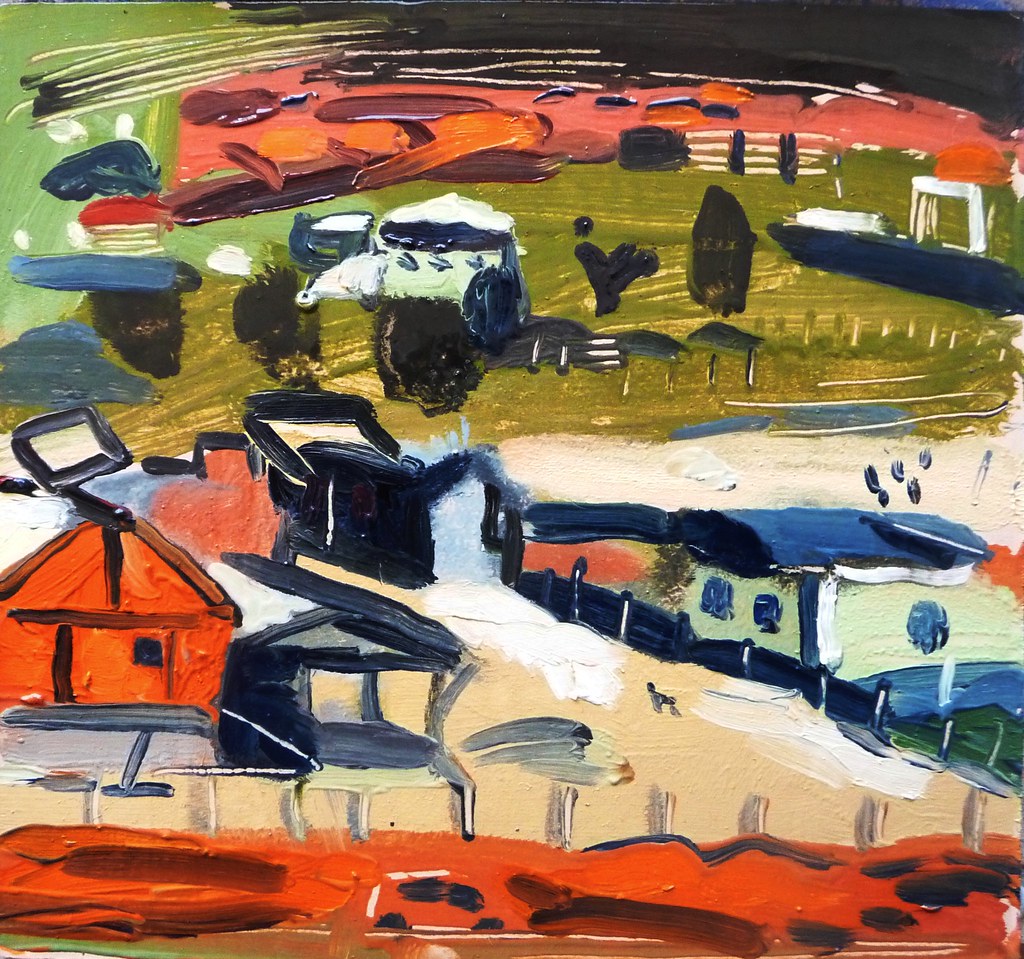


Pedra Branca, lost dog, oil on card, 13.5 x 14.5 cm


I watch with a mixture of bemusement, horror and a sort of perverse admiration as I see another town being constructed here. Brazilians have heard of planning, they even have a planned capital, and very striking it is too, and a planned state capital called Curitiba, but plainly urbanism isn`t something they really want to spend too much of their time bothering with, like the British with cooking and dance.

*

I am trying to set up my New York trip for October. If you can advise on any art contacts, dealers, or galleries that might like my work please let me know.

*

My painting trips have aways confounded my expectations- generally the better I think it is going to be, the worse it is. And the more preconceptions I have about a place, usually garnered from books, films and photos, conversations. the more the reality surprises, or disappoints me.

Generally small unknown places are best- you arrive there without preconceptions, style uncrampted and after, when looking at your pictures no one can respond- Oh but that`'s not how I remember suchandsuch!

I dislike both shoebox modern glass architecture, and molten wax baroque: neither are fun to paint.  Deco is good- so is austere Scottish Georgian. Both have a clear geometry that catches the light. But Po.Mo is nasty. I agree, if one likes Deco one should probably like Foster and Stirling, but somehow they are displeasing, in part because of their awful palette and insistence on humour (groan).

Trashy make-it-up-as-you-go-along Brazilian slum architecture is fun too, with bright colours. jumble, and blurring between interior and exterior spaces, so the private and the public are not so harshly distinguished. And there is still a street life here, at least in poorer neighbourhoods, something which has been virtually banished from the UK.

My notions of New York are founded on a distant memory of the three day trip there back in 1992, books by Singer, Paul Auster, Fitzgerald, Dorothy Parker and Joseph Mitchell; photos by Steiglitz and Feininger and Weegee; films by Woody Allen and Scorsese and songs by Lou Reed.. I.e a peculiar mixture of the sinister and the sentimental and down at heal, or downright squalid, and mostly located between 1920 and 1979.

Much of what I paint in a city is conditioned by where I can comfortably sit, preferably without either traffic bums or salespeople bugging me. Ergo, waterfronts are good, as are cafes at corners and places which are high up. Were I a photographer, my subjects would be considerably different, with much more movement.

Tuesday, September 15, 2009

Personal Art


Man with a Vagina for a Mouth

I was often told by tutors at Edinburgh College of Art that my work was “personal”. I think what they meant was that it appeared to provide access to a private self: scratchy drawings, images of fantasies, a specific, hard-to-imitate way of making marks. A couple of tutors suggested that I abandon oil painting and focus on ink and watercolors.

The problem for me was that I didn’t really want to found an artistic career on something “personal”. I wanted to build my artistic career on an idea of classicism. I’d somehow absorbed Goethe’s idea the Classicism = health and romanticism = sickness, and that “personal” art was a romantic product. I’d also absorbed the idea that discipline was an essential element in the creation of art. I was a rather moralistic young person (I’ve noticed since then that young people are often very priggish indeed), and I felt that the mission of art should incorporate moral terms. This somehow seemed absent from the sort of drawings (illustrated above) that the tutors were referring to, partly because they were dependent on humour, an element always absent in any moralizing aesthetic. And I felt that these drawings were a side alley, a diversion, and there wasn’t enough there to sustain my interest. I didn’t think I could spend all day making little drawings like the one above.

This was the 80s*; there was a revival of painting going on. I went to a very traditional art college: the training roughly Beaux Arts in structure, with compulsory anatomy, life drawing and strict distinctions made between drawing, painting, high and applied arts (a hierarchy where oil painting is at the top, and drawing and applied arts at the bottom).

Also, I had a good element of perversity, in that I would do the opposite of what was suggested by tutors (it was ironical, looking back that they had, in a way suggested producing work which was a-typical of the college course expectations, by raising drawings to the level of finished paintings. I suspect that those tutors were bucking the official line: there had been problems with students who’d produced degree shows consisting only of drawings, because the College had a defined their Fine Art course as consisting of two examined specialisms, “drawing” and “painting”).

Anyway, I was unable to value my specific talents, seeing them as somehow necessarily inferior to the methods and ends of artists (usually old masters) in museums.

But my “classical” paintings were in fact simply paintings that negotiated established conventions) and consequently they were often dull, and it was only when I accessed my “personal side” usually in drawings that I made things at all memorable.


* Moreover Scottish figurative painters had managed to establish themselves prominently in the cultural and commercial spheres (specifically Stephen Conroy, Peter Howson, Stephen Campbell, John Bellany, and Adrian Wiszniewski). There was a culture war going on with painters fighting post-modernism (pluralism), and I was on the side of painting, mainly because I valued craft, and did not see craft as being valued in modern art. In retrospect, pluralism won: you can do what you like. My fear of pluralism in Art (postmodernism) was that if all forms of expression were permitted and everything was art, then how would a language of art ever be developed? Surely, only by following a tradition could one hope to clearly communicate anything, because an artist needed a language and a language was a shared cultural inheritance, a tradition? But I think that fear hasn’t been realised. You can “push the boat out”: there are always precedents to make meaningful comparisons so that something is conveyed in your expressions, however fanciful. And in the end, it’s only art, it doesn’t really matter that much, no-one is going to get hurt, and much of the argument and discussion of the 80s that I lived through has more to do with ego than really coming to terms with what visual communication can or should be.

It should also be recalled, when we criticise post-modernism for being intellectually flabby, how restricted art practise was prior to the war: a writer was not allowed to aping, a painter could not do illustrations and a poet could not also be a novelist. There were many exceptions, of course, but they were remarked upon, as such).

Sunday, July 5, 2009

Style

*


Until a few years ago I believed that an artist should have one style. This was proof of something called authenticity, which I believed was the basis of good art. I believed in authenticity because I was quite serious, and because I had a puritanical streak, and because it was the cultural norm at the time.

This meant that art had also to be difficult, both technically and in terms of comprehensibility.

In the last few years my attitude has changed, however. It's not that my previous beliefs are invalid, it's more that I see the easy possibility of them existing alongside other beliefs- an artist can be playful, slight and entertaining or populist one day, serious and elevated the next.

This is by way of an explanation of the variety of styles and approaches I am using. They each allow me to express different things, and the one does not cancel out the other.

These statements may seem obvious, but it should be born in mind that until Post-modernism really set in - and in Scotland, where I trained, this was not until the late 90s- artists were expected to restrict themselves to one medium, one subject, so that if an abstract expressionist painter in acrylics decided to produce a figurative lithograph this was viewed with some suspicion. I suspect that some of the suspicion was led by marketing concerns- it's much harder to market an artist whose work varies enormously.

But given how little art most artists sell, and I include myself- worrying about providing a consistent product seems extremely vain, to say the least.